Mark your calendars: Singapore calls for a general election on May 3 and parliament dissolution
Summary
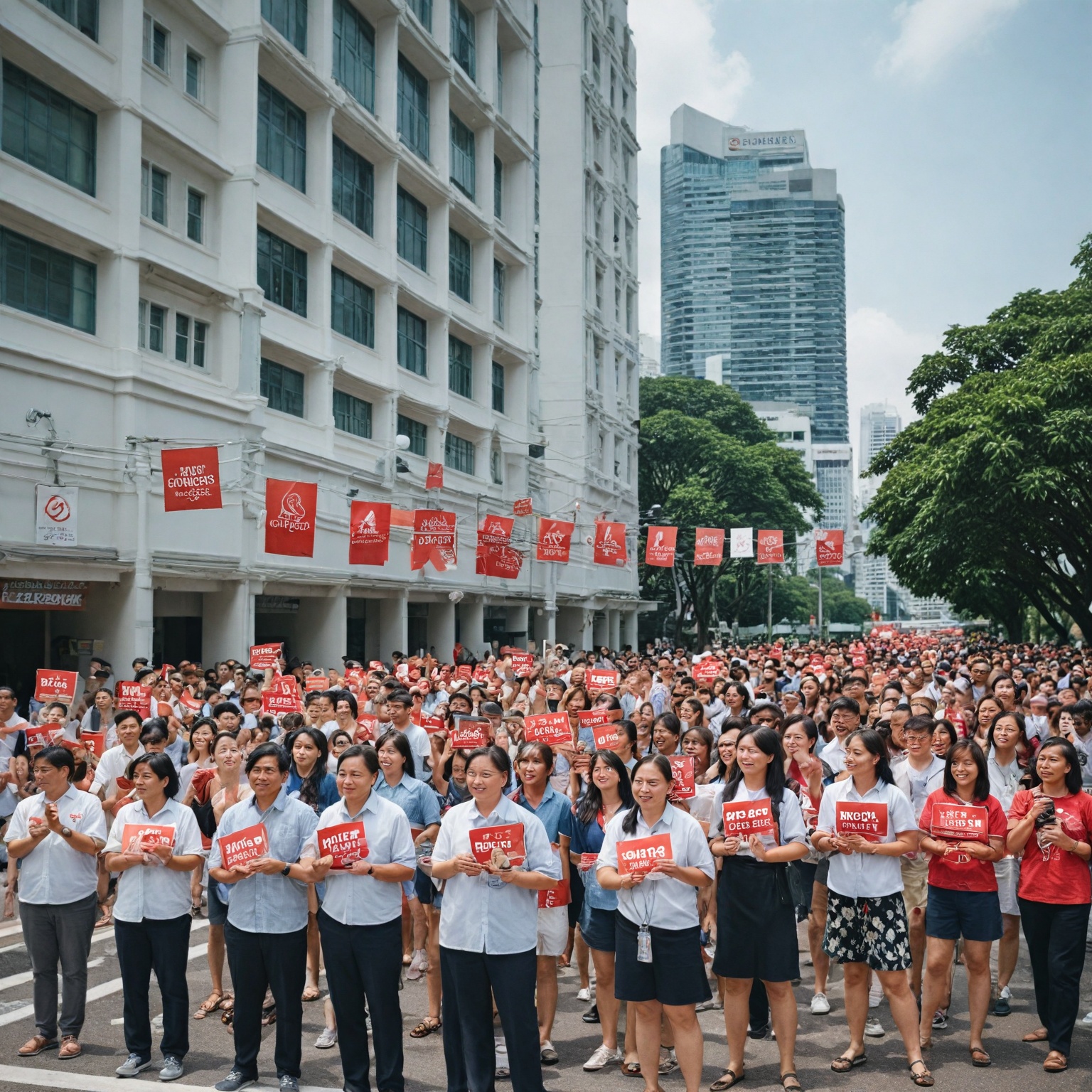
Singapore has announced a general election to be held on May 3, with the dissolution of the existing parliament, operating under a parliamentary political system. The People’s Action Party (PAP) has been the dominant party since 1959, and in the latest elections in July 2020, there were a total of 11 contesting parties. Despite the multi-party system, controversy surrounds the boundary process, which is often controlled by the PAP and is considered to give the party an electoral advantage. The Singaporean Parliament, composed of elected Members of Parliament (MPs), has a term of five years but can be dissolved earlier based on the Prime Minister’s advice.
In recent times, social media influencers have played a significant role in spreading political awareness and interviewing opposition candidates. However, there have been issues with the election process, particularly around election campaigns. These campaigns must be free from foreign influence and should not contain false statements or unfounded allegations. Yet, the PAP has been known to use tactics, such as controlling the boundaries process and imposing strict eligibility rules, to maintain its political dominance.
The role of the Returning Officer, appointed by the Prime Minister, has been emphasised as they have the authority to instruct individuals and social media platforms to remove online election advertisements that violate regulations. As the upcoming election draws closer, the role of social media is being underscored, with politicians and political parties focusing on increasing their online presence.
Predictions for the upcoming election indicate a continuation of recent trends, with the PAP’s traditional “flight to safety” strategy potentially facing challenges amid growing voter skepticism and a more diverse electorate. However, as with all predictions, these remain speculative until the final results are published in the Singapore Government Gazette, after overseas votes are counted.
Background
Singapore operates under a parliamentary political system, dominated by the People’s Action Party (PAP) and the Lee family since 1959. The country has a multi-party political system, with a total of 11 parties that contested in the parliamentary elections in July 2020. Despite the multi-party system, the boundaries process is often controlled by the PAP, providing an advantage for the party in elections.
The Singaporean Parliament, which consists of elected Members of Parliament (MPs), has a term of five years but can be dissolved at any time on the advice of the Prime Minister. This power has been utilized to advantage by the ruling party, with new electoral districts often announced shortly before elections. The general election must be held within three months of the dissolution of the Parliament. The parliamentary system of Singapore also ensures ministerial accountability and controls the nation’s finances.
In the event of a parliament dissolution, Singapore’s government retains decision-making power until elections are over and a newly elected government is sworn in. Prime Minister, who retains his position even after dissolution of the Parliament, plays a crucial role in appointment of the Cabinet and other key positions by advising the President.
In recent times, social media influencers have played a crucial role in elections, interviewing opposition candidates and spreading political awareness. Despite the dominance of PAP, opposition politicians have been elected into Parliament since 1965. The PAP’s unbroken streak of election victories since Singapore’s independence is also notable.
However, the election process is not without controversy. It is mandated that election campaigns must be free from foreign influence and should not contain false statements or unfounded allegations. Despite this, the PAP has been known to use various tactics, such as controlling the boundaries process and imposing onerous eligibility rules, to maintain its dominance in politics.
Call for General Election
In the past, the government held that the Prime Minister had the discretion to decide whether or not a by-election should be called to fill a casual vacancy in an SMC, and could leave a parliamentary seat unfilled until the next general election . However, the Court of Appeal ruled in the case of Vellama d/o Marie Muthu v. Attorney-General (2013) that the Constitution obliges the Prime Minister to call a by-election unless a general election is imminent .
Following Lawrence Wong’s appointment as Singapore’s next prime minister in May 2024, speculation arose that elections could be held as early as September that year . Observers pointed out that elections often coincided with school breaks in March and September . Analysts on CNA noted that the PAP’s traditional “flight to safety” strategy – appealing to voters to stick with familiar leadership during crises – might not be as effective in the upcoming election, given increasing voter skepticism and a more diverse electorate .
On 31 May 2024, the ELD announced that the Returning Officer, appointed by the prime minister, would have the authority to instruct individuals and social media platforms to remove online election advertisements that violate election regulations . The ELD also decided to discontinue special arrangements at nursing homes, which were first implemented in the 2023 presidential election, due to logistical issues and mixed reception .
Candidates are advised against making false statements, unfounded allegations of corruption or criminal offenses, or statements that could incite racial or religious tensions or affect social cohesion . The ELD sets a spending limit for electoral campaigns, currently set at S$4 per elector .
Election Procedures
The procedures for general elections in Singapore are overseen by various regulatory bodies, including the Elections Department Singapore (ELD), the Returning Officer appointed by the Prime Minister, and the Parliament of Singapore. These procedures include nomination, campaign regulations, voting, and electoral boundaries.
Nomination
Nomination is an essential process in Singapore’s general elections. It requires the prospective candidates to deliver their nomination papers to the Returning Officer between specific times. These papers require the personal particulars of the nominee, endorsements from a proposer, seconder and four to eight assenters, and a statutory declaration by the nominee stating that they are not a member of a political party and understand the President’s constitutional role.
Campaign Regulations
Election-related activities in Singapore can only be conducted by candidates, their election agents, or third parties authorized in writing by the candidates or their agents. The ELD sets spending limits for electoral campaigns, currently at S$4 per elector. Additionally, the Returning Officer has the authority to instruct individuals and social media platforms to remove online election advertisements that violate election regulations.
Voting
Voting in Singapore involves several innovative and streamlined methods. Electronic registration has been used since 2018 to register voters at polling stations, making the process faster than the previous practice of manually checking names against a hardcopy register. In addition to in-person voting, the ELD introduced a postal voting trial for overseas Singaporeans in 2023, allowing them to cast their votes at overseas missions and government offices.
Electoral Boundaries
The delineation of electoral boundaries in Singapore is a process that has been subjected to criticism in the past due to perceptions of favoring the ruling political party. However, it is the responsibility of the Elections Department to determine these boundaries, and they do so without the need for parliamentary approval.
Roles in Parliament
In the Parliament of Singapore, the Speaker’s role is significant as they provide guidance on procedures, make rulings on points of order, and act as the Parliament’s representative in relations with other legislatures and outside bodies. In addition, the Speaker sits at the same level as the chief justice of Singapore in terms of state protocol. Furthermore, the Serjeant-at-Arms is responsible for maintaining order within the precincts of the House, while the clerk can only be removed from office through a parliamentary resolution.
Campaigns and Strategies
In the lead up to the general election, the various political parties and candidates engage in a variety of election-related activities. These activities must adhere to a code of conduct, ensuring their campaign is free from foreign influence and does not involve false statements or unfounded allegations.
Use of Social Media
In recent years, social media has become a critical component in election campaigns, allowing candidates to directly engage with the public. Popular influencers and online platforms like YouTube have been utilised to interview candidates and spread their messages. For example, in the 2020 General Election, influencer Preeti Nair interviewed opposition candidates for her YouTube channel. Despite resource limitations, parties such as the Workers’ Party (WP) and Red Dot United (RDU) have been actively updating their social media accounts and engage with voters.
However, it is important to note that while social media is crucial for voter outreach, voters are unlikely to rely solely on these platforms in making their voting choices.
Candidate Selection and Party Strategies
The nomination paper for candidates requires personal particulars, candidacy endorsements and a declaration of understanding of the President’s constitutional role. Party strategies vary, with some engaging in continual public engagement even outside of election periods. For example, Tan Cheng Bock, founder of the Progress Singapore Party (PSP), continued his walkabout and rallying at West Coast GRC despite not revealing specific election plans.
In the case of the ruling party, leadership changes and cabinet reshuffles are often strategic moves ahead of the election. For instance, Finance Minister Lawrence Wong was selected as the leader of the 4G team in April 2022 and was subsequently appointed Deputy Prime Minister in June the same year.
Addressing Public Concerns
Aside from everyday concerns like public housing and living costs, opposition parties have also been encouraged to address larger geopolitical matters that can significantly influence domestic issues. It is also recommended that parties participate in co-operative international schemes beneficial to Singapore.
Minority Representation
To ensure that minority groups are represented in Parliament, the Singapore constitution guarantees a set number of parliamentary seats for the opposition. These seats may consist of elected members of parliament (MP) from the opposition team and unsuccessful candidates in this election from the best-performing losing opposition party or parties, collectively known as Non-constituency Member of Parliament.
Electoral Districts
The electoral districts for each election are announced ahead of the election date, with the 2020 districts announced four months before the elections. This process, along with the GRC system and eligibility rules for presidential candidates, have been criticized for favoring the ruling party, the People’s Action Party (PAP).
Impact and Significance
The calling of a general election in Singapore carries a significant impact on both the political and societal landscape of the country. Firstly, it brings into focus the issue of political strategies, with opposition parties pushing for broader conversations beyond everyday concerns such as public housing and living costs to include global geopolitical matters which can significantly influence domestic issues. Opposition parties have also been leveraging social media platforms to level the playing field, reach out to, and engage directly with Singaporeans.
In addition to this, the role of parliamentary proceedings in the conduct of legislative business and fostering democratic deliberation becomes even more critical during election times. An approach towards policies that focus on strength and abundance instead of fear and scarcity has been recommended to better cater to societal aspects like inequality, participation, mental health, and readiness for the future.
The lead-up to the elections has been characterized by strategies aligning with the international trend seen in 2024, as politicians around the globe incorporated emerging forms of media into their campaigning apparatus. However, Singapore’s electoral system has been criticized for favoring the political establishment. This includes the Group Representation Constituency (GRC) system introduced in 1988 aimed at improving ethnic representation, but often criticized as a form of gerrymandering reducing opposition representation.
The advent of the digital era has also raised concerns about the potential impact of foreign-based social media platforms possibly manipulating their algorithms to affect the social media reach of particular candidates or groups during an election period.
Finally, it’s significant to highlight that, despite being the dominant force in Singaporean politics, the ruling party has seen an increase in opposition MPs, signaling a complex reality behind its popularity. This indicates a growing multi-party system and a more diverse electorate, highlighting the increasing significance of these general elections in shaping Singapore’s political future.
Expected Outcomes and Predictions
Singapore’s political landscape has been dominated by the People’s Action Party (PAP) since the country’s independence in 1965. The PAP has consistently won an overwhelming supermajority in parliament, a trend that some attribute to the party’s popularity due to Singapore’s economic advancement. In the 2020 General Election, the PAP won 83 seats out of 93, with a voter share of 61.24%.
However, the political landscape has shown signs of change. In the 2020 General Election, a swing to the opposition saw the Workers’ Party (WP) make significant gains in parliament, with WP chief Pritam Singh formally designated as the Leader of the Opposition. This was seen as a significant political event, as it marked the highest number of opposition MPs since Singapore’s independence in 1965.
Predictions for the upcoming general election indicate a continuation of this trend. The WP, having secured a breakthrough with their triumph in Sengkang GRC in 2020, continues to advocate for a balanced political landscape, offering constructive alternatives to the ruling party. Other parties, such as the Progress Singapore Party (PSP), are also emerging as significant players in the opposition.
The PAP’s traditional “flight to safety” strategy, appealing to voters’ familiarity with the party during times of crisis, may face challenges amid growing voter skepticism and a more diverse electorate. Geopolitical matters and issues like public housing and living costs are predicted to significantly influence domestic issues, prompting opposition parties to address them in their campaigns.
The release of the Report of the Electoral Boundaries Review Committee marked a key step toward this year’s election. This announcement usually indicates that the general election is imminent. However, the boundaries process, controlled by the PAP, has been criticized for providing an advantage for the ruling party.
Given these factors, the upcoming election could see candidates from 11 parties, including two opposition alliances. With the increasing use of digital platforms and social media in campaigning, the election process may reflect international trends observed in 2024.
It is important to note, however, that predictions remain speculative until the final results are published in the Singapore Government Gazette, after overseas votes are counted. Regardless of the outcome, the aim remains to uphold the principles of fair and lawful campaigning, as detailed by Singapore’s election laws.
The content is provided by Sierra Knightley, The True Signal